
Quantum at Work: Where Enterprises Can Actually Use Quantum Today
Eve Count Quantum Systems · Gwen Yi & Benjamin Lim · Open Session & Enterprise Cohorts
Quantum readiness is an engineering and mathematical discipline, not a hardware procurement exercise. Separate coupled combinatorial bottlenecks from linear workloads, establish an honest classical baseline, and require measurable operational evidence before committing capital.
Start Chapter 01 Explore the 8 Chapters Sign Up for Open Session & Cohorts
Welcome
This technical companion turns the core methodology from Quantum at Work into an inspectable, hands-on engineering walkthrough. You can follow the eight chapters alongside the Open Session or work through the exercises with your architecture and operations teams during our 2-Day Corporate Intensive.
The running example models a constrained enterprise allocation and scheduling bottleneck (applicable to berth and crane scheduling, pit-to-port blending, fleet routing, and intraday liquidity allocation). A deterministic Python harness—not vendor marketing claims—decides whether a workload belongs on a classical solver, a classical metaheuristic, or a hybrid QUBO formulation. No paid quantum cloud account, API key, or proprietary SDK is required to run the exercises.
Get ready
Use Python 3.10+ and any modern code editor (VS Code, Cursor, or Google Antigravity) to run the exercises.
To run the companion harness locally, clone the quantum-at-work repository and execute:
Every chapter includes a runnable Python verification snippet, an AI-assisted architecture prompt, and an observable governance checkpoint.
Designed for two speeds
Executive & Architecture Track (25–45 mins): Follow the architectural plates, decision boundaries, and governance checkpoints across the eight chapters.
Hands-on Engineering Track (60–90 mins): Run the Python snippets, inspect examples/combinatorial_triage.py, and test the penalty calibration and SLA gate boundaries on your own operational constraints.
The Evidence-Before-Advantage Loop
Specify → Baseline → Formulate → Triage → Benchmark → Govern.
Quantum and hybrid solvers can unlock measurable basis-point improvements on tightly coupled discrete problems, but enterprise owners remain accountable for data hygiene, SLA latency envelopes, and classical parity benchmarks. A vendor demo without a tuned classical baseline is never sufficient evidence for production deployment.
Choose your chapter
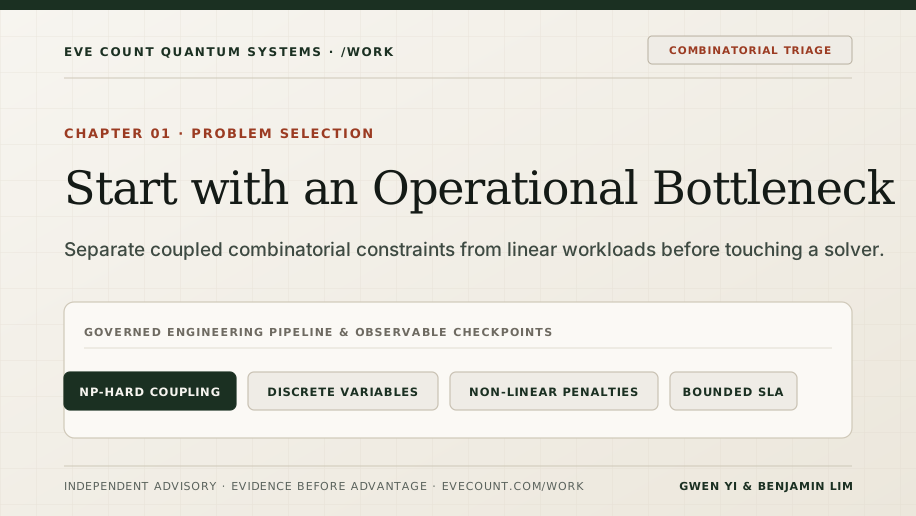 01 · Start with an operational bottleneck
Separate coupled combinatorial constraints from linear workloads before touching a solver.
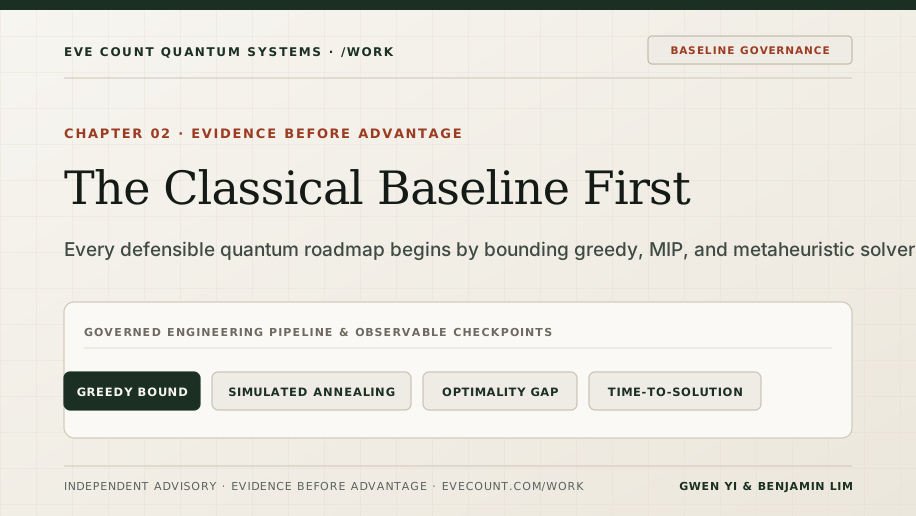 02 · The classical baseline first
Bound greedy, MIP, and metaheuristic performance before claiming quantum uplift.
 03 · Formulating constraints & penalties
Translate operational rules into inspectable QUBO matrices and calibrated penalty weights.
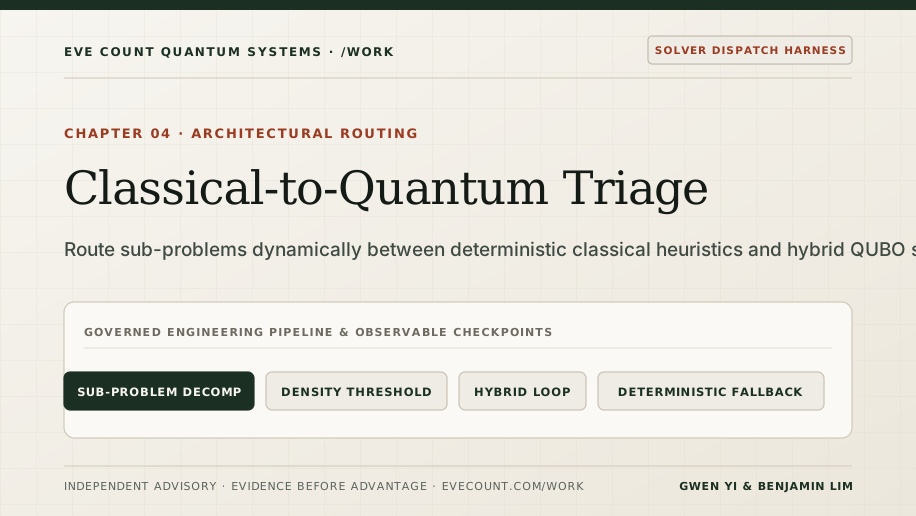 04 · Classical-to-quantum triage
Route sub-problems dynamically between deterministic classical heuristics and hybrid solvers.
 05 · Data, latency & SLA boundaries
Why real-time SLA timers and incomplete ERP telemetry invalidate naive PoCs.
 06 · Cryptographic exposure vs. optimization
Separate near-term combinatorial optimization value from Post-Quantum Cryptography (PQC) timelines.
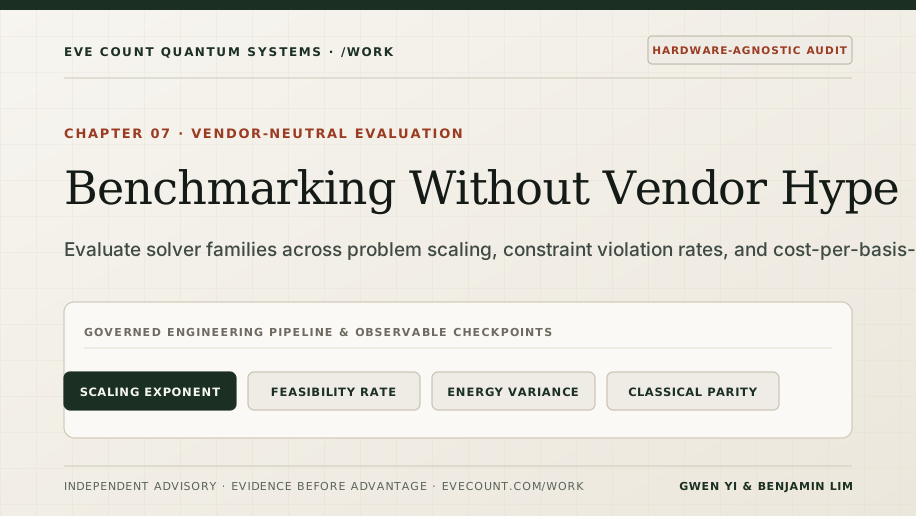 07 · Benchmarking without vendor hype
Evaluate solver families across scaling behaviour, feasibility rates, and cost per basis point.
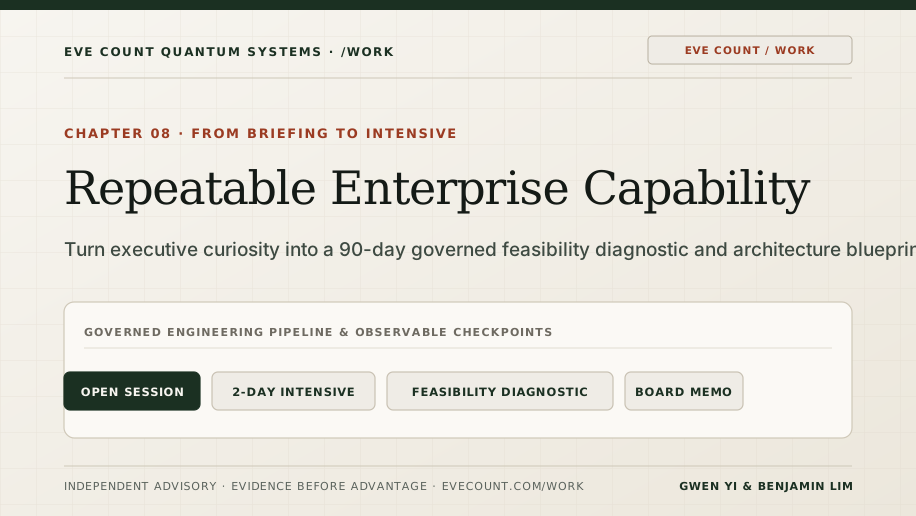 08 · Repeatable enterprise capability
Move from executive briefings to a 2-Day Corporate Intensive and 90-day Feasibility Diagnostic.
Continue learning · Cohorts & Briefings
Open Session registration (Rolling Registration), Corporate Intensive syllabus, and diagnostic intake.