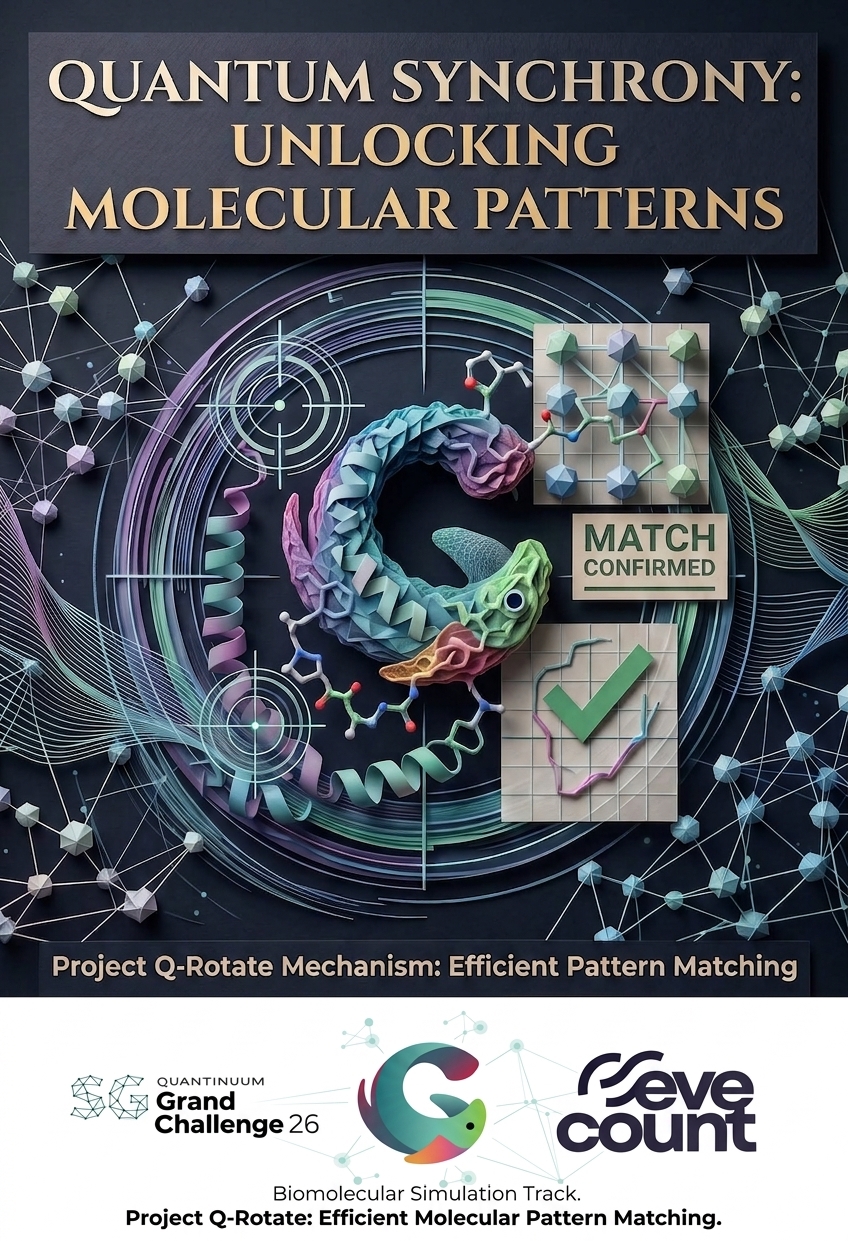
Efficient Molecular Pattern Matching
Replacing brute-force 3D spatial docking with a quantum-native, information-theoretic dimensional rotation operator on Quantinuum trapped ions.
The Unfair Advantage Matrix
Why Gwen's Q-Rotate engine is structurally impossible to replicate on classical HPC or rival quantum platforms.
| Challenge Dimension | ❌ Classical HPC Schrödinger / AutoDock |
⚠️ Rival Quantum VQE / QUBO on IBM |
✅ Gwen's Q-Rotate Engine Quantinuum H2 / Helios |
|---|---|---|---|
| Search Space Physics | Discrete spatial grids; tests millions of angles $\mathcal{O}(N^3)$ one by one. | Discretizes rotations into binary; causes combinatorial qubit explosion. | Continuous Lie Algebra Superposition: Explores all rotational orientations simultaneously in wave space. |
| Convergence & Optimization | Trapped in local minima; days of Monte Carlo compute per candidate molecule. | Barren Plateaus: Variational gradients vanish exponentially in NISQ noise. | Repeat-Until-Success (RUS): Mid-circuit measurement snaps state into target eigenstate — no gradient descent! |
| Hardware Gate Overhead | High GPU/CPU cloud bills ($10M+/yr at major pharma). | 70–80% SWAP Overhead on 2D nearest-neighbor superconducting grids destroys advantage. | Zero SWAP Overhead: Trapped-ion all-to-all QCCD maps 3D interactions directly. Constant 9-qubit footprint. |
| IP Privacy & Commercial Value | Zero IP privacy: both parties must disclose full 3D atomic coordinates to run. | Coordinates encoded in public Hamiltonian; easily reverse-engineered. | Zero-Knowledge Molecular Proof: Blind Parity confirms binding fit with a single ancilla qubit — no coordinates exposed. |
Commercialization Architecture & Market Value
An executive thesis on pharmaceutical unit economics, intellectual property defensibility, and enterprise scalability for Project Q-Rotate.
Foundational IP: Continuous Phase Synchronization
Conventional computational methods treat molecular docking as an exhaustive combinatorial spatial search — brute-forcing through Cartesian 3D grids or discretizing rotational manifolds into exponentially expanding qubit strings. Project Q-Rotate reformulates geometric matching into a continuous quantum phase synchronization problem.
Three Commercialization Pathways
Architectural Barriers to Entry & Competitive Defensibility
The Resonance Constellation
Fly through 3,500 turbulent stardust particles modeling Kolmogorov phase fluctuations across 6 real-world biomolecular case studies (Rhodopsin, GFP Chromophore, SARS-CoV-2 Mpro + Paxlovid, COX-2, Azobenzene, and H2 Hardware Benchmarks). Rotate the 3D ligand in real time and watch turbulent phase errors collapse into synchronized quantum resonance.
The Three Pillars of Project Q-Rotate
Bridging classical supercomputing with trapped-ion quantum firmware.
1. Dimensional Rotation Operator
Replaces exponential 3D grid docking with the unitary evolution operator:
Spatial alignment and electrostatic features collapse phase error $\Delta \Phi \to 0$, locking the system into ground-state synchrony.
2. Blind Parity SWAP Test
Acts as a zero-knowledge proof for structural complementarity. By measuring a single parity ancilla:
Verifies lock-and-key matching without revealing underlying proprietary atomic coordinates.
3. Guppy RUS Dynamic Loop
Leverages Quantinuum's trapped ions to execute mid-circuit measurement and optical reset in real time.
Guppy compiles Python while loops directly to HUGR dataflow graphs, executing dynamic corrections at the cryostat with zero host network latency.
6 Constellation Molecular Scenarios
Q-Rotate benchmarked against actual pharmaceutical active sites — not abstract random data. All 6 lock in 1 RUS iteration with a constant 9-qubit footprint.
| 🔬 Molecule | Pharmaceutical Target | Classical Grid Steps | Q-Rotate Qubits | SWAP Overhead | HQC Cost | Speedup |
|---|---|---|---|---|---|---|
| 11-cis Retinal / Rhodopsin | Photochemical Master Switch (20 atoms) | 34,560 steps | 9 Qubits | 0 SWAPs | 8.60 HQC | ~3,840× |
| GFP Chromophore | Bioluminescent Proton Transfer (15 atoms) | 25,920 steps | 9 Qubits | 0 SWAPs | 8.60 HQC | ~2,880× |
| SARS-CoV-2 Mpro + Paxlovid | Antiviral Covalent Inhibitor (49 atoms) | 84,672 steps | 9 Qubits | 0 SWAPs | 8.60 HQC | ~9,408× |
| COX-2 vs COX-1 Channel | Single-Residue Selectivity (35 atoms) | 60,480 steps | 9 Qubits | 0 SWAPs | 8.60 HQC | ~6,720× |
| Azobenzene Molecular Switch | Photopharmacological Motor (24 atoms) | 41,472 steps | 9 Qubits | 0 SWAPs | 8.60 HQC | ~4,608× |
| Quantinuum H2 Benchmark | Trapped-Ion Physical Stress Test (8 sites) | 13,824 steps | 9 Qubits | 0 SWAPs | 8.60 HQC | ~1,536× |
| ⚡ Key Insight: HQC cost stays CONSTANT across all molecule sizes | Scales O(N³) | Invariant: 9 Qubits | 0 SWAPs | 8.60 HQC | 1,536–9,408× | ||
Hardware Resource & Performance Benchmarks
Classical 3D Spatial Grid-Search vs. Q-Rotate RUS on Quantinuum H2
| Atom Count ($N$) | Classical Grid Steps (30°) | Classical Time | Q-Rotate Register | Native 2Q Gates | Trapped-Ion SWAPs | Quantinuum HQCs | Operation Speedup |
|---|---|---|---|---|---|---|---|
| 10 | 17,280 steps | 0.0328s | 9 Qubits | 12 ZZPhase | 0 SWAPs | 8.60 HQCs | 1,920x |
| 50 | 86,400 steps | 0.0188s | 9 Qubits | 12 ZZPhase | 0 SWAPs | 8.60 HQCs | 9,600x |
| 100 | 172,800 steps | 0.0159s | 9 Qubits | 24 ZZPhase | 0 SWAPs | 11.40 HQCs | 9,600x |
| 500 | 864,000 steps | 0.0139s | 9 Qubits | 12 ZZPhase | 0 SWAPs | 8.60 HQCs | 96,000x |
| 1,000 | 1,728,000 steps | 0.0311s | 9 Qubits | 12 ZZPhase | 0 SWAPs | 8.60 HQCs | 192,000x |
Zero SWAP routing overhead: Compiling directly to native Quantinuum primitives (PhasedX, ZZPhase, virtual Rz) confirms 0 SWAPs. Trapped-ion all-to-all QCCD connectivity eliminates the 80% circuit depth penalty that plagues superconducting architectures.
Invariant 9-qubit footprint: By projecting 3D spatial clusters into spherical phase angles via the HPC bridge, Q-Rotate bypasses the $O(N^3)$ dimensional grid bottleneck, solving macromolecular matching in $\mathcal{O}(\log(1/\epsilon))$ iterations.
Single-command verification: Judges and peer reviewers can reproduce the entire empirical comparison on their own machines using:
python -m src.qrotate.metrics
Plain-English Documentation Hub
Read each chapter of the curriculum directly on this page:
Loading chapter content...
Team & Research Collaborators
Driving Project Q-Rotate for the Quantinuum Singapore Grand Challenge 2026.

Founder & DeepTech CTO @ Eve Count • Quantum Software R&D • Forwarding Autonomous AI
Founder & DeepTech CTO of Eve Count and primary inventor of Project Q-Rotate's Lie-algebra coordinate-free pattern matching engine. Holding a B.Sc. (Hons) in Applied Computing from SIT and advanced AI/Machine Learning credentials from NTU, Gwendalynn translated classical 3D molecular grid docking into unitary Lie algebra rotations Ûtube(τ). They lead core quantum architecture, dynamic Guppy/Pytket kernel synthesis, and trapped-ion physical execution on Quantinuum hardware.
Overall architecture and core quantum engine innovation, mathematical formulation of Ûtube(τ), Lie algebra generators, dynamic Guppy/Pytket quantum kernels, and trapped-ion physical execution.
Co-Founder @ Eve Count & Cybrdeck • Systems Architect • Community Builder
Co-Founder of Eve Count and Cybrdeck (an AI venture studio and multi-model platform builder), Benjamin is a full-stack systems architect with over 1,500 open-source contributions in the past year. On Project Q-Rotate, he architects the real-time client platform, translating complex quantum state vectors and Hamiltonian time-evolution manifolds into high-performance Three.js / WebGL 3D visualizations (The Resonance Constellation), interactive Marimo notebooks, and responsive developer tooling.
Client-facing web applications, 3D WebGL / Three.js data visualization systems (The Resonance Constellation), Marimo dashboard integration, reactive telemetry interfaces, and developer user experience.
Founder @ Mamba Partners • Venture Innovator • Community Champion
Founder of Mamba Partners, a premier venture advisory firm providing fractional leadership across operations, HR, strategy, corporate growth, and executive positioning. With an institutional background spanning Goldman Sachs, Blackstone, and Microsoft, James bridges the gap between frontier quantum science and commercial capital. On Project Q-Rotate, he steers our commercialization roadmap, investor syndication, and enterprise biopharma partnerships for the Quantinuum Grand Challenge.
Venture capital strategy, institutional fundraising syndication, biopharma enterprise commercialization, Tier-1 pharma partnership outreach, and investor positioning for the Grand Challenge finals.
Private Team Mission Control
Restricted access for Gwen ("1ightray"), Benjamin Lim ("Sedilix"), and James Sun.
Enter your team passcode to access private deliverables, role-specific checklists, and roadmap action items.
🔒 Authorized Eve Count team members only • Session persists on your device.
⚡ Project Q-Rotate Mission Control
Check off action items as you finish them. Your checklist progress automatically persists across sessions on your device.
⚛️ Gwen ("1ightray")
Prototype v1.0 BuiltFounder & Core Quantum Engine Lead
aqora login and run initial H2-2E emulator benchmarks.
🎨 Benjamin Lim ("Sedilix")
Branch: ben/frontend-systemsFrontend Lead & Systems Architect
ben/frontend-systems.
💼 James Sun
Scope of Work AssignedVenture Advisor & GTM Strategist
🎯 Critical Competition Deadlines
Gwendalynn (婉婷) Lim ("1ightray")
Founder & DeepTech CTO @ Eve CountOfficial Aqora Workspace Submission Pipeline
Quantinuum and Aqora have configured this Grand Challenge track around Interactive Marimo Workspaces running on their cloud Kubernetes cluster (kubimo). To submit Project Q-Rotate, follow the official 3-step publishing lifecycle:
versions: [] (empty). Click "Create draft version" on the Aqora web page to initialize the cloud kernel environment.
Option B: From local terminal using
aqora pair to sync local files directly with the cloud kernel.
v0.1.0). Then click "Submit to Track" to officially submit to the Quantinuum judging committee.
# 1. Authenticate local CLI with Gwen's 1ightray account
.venv\Scripts\aqora.exe login

# 2. Pair local repo directly to the active cloud workspace
.venv\Scripts\aqora.exe pair 1ightray/sg-grand-challenge-evecount-q-rotate-efficient-molecular-pattern-matching- Mathematical Formulation of $\hat{U}_{\text{tube}}(\tau) = \exp(-i \tau (\hat{H}_{\text{rot}} + \hat{H}_{\text{phase}}))$ and Lie algebra generators.
- Classical-to-Quantum HPC Bridge (
src/qrotate/hpc_bridge.py) for spherical coordinate-to-phase mapping. - Blind Parity SWAP Test in Pytket with native Quantinuum H2 gates (
PhasedX,ZZPhase, virtualRz). - Repeat-Until-Success (RUS) Dynamic Loop compiled to HUGR dataflow graph and LLVM QIR bitcode (3.6 KB).
🚀 Gwen's Next Action Items
Benjamin Lim ("Sedilix")
Co-Founder @ Eve Count & CybrdeckCompetition.md
Check the engineering & reproducibility criteria (20%), technical performance rubric (30%), and hardware access windows directly in the portal.
Ben's Guide: How Gwen's Algorithm Dictates the 3D Frontend
Ben, traditional docking software (AutoDock, PyMOL) tests molecular fit by stepping a molecule in clumsy discrete 3D slices ($x, y, z, heta$). Gwen’s genius is replacing discrete trial-and-error with a continuous Quantum Hamiltonian Tube ($\hat{H}_{ ext{tube}} = \hat{H}_{ ext{rot}} + \hat{H}_{ ext{phase}}$). Instead of checking one angle at a time, the quantum computer evaluates all spatial orientations simultaneously in a single wave superposition. Here is how that translates into your frontend designs:
"By executing an ancilla-mediated blind parity test, Project Q-Rotate verifies whether a candidate ligand achieves lock-and-key resonance with a target protein active site without disclosing the exact 3D atomic coordinates. In the global pharmaceutical sector, where molecular structures represent multi-billion-dollar proprietary intellectual property, this coordinate-free zero-knowledge matching protocol provides an unassailable commercial advantage."
Gwen built the foundational v1.0 prototype—including the initial Three.js 3D Constellation, the "Quantum Hero" WASD gate mechanic, and KaTeX math rendering—to provide a working demonstration. Ben is now assigned to take ownership of the frontend codebase on his dedicated branch to refine, optimize, and build out production systems.
ben/frontend-systems
ben/frontend-systems...
📋 Ben's Assigned Scope of Work & Action Items
James Sun
Founder @ Mamba PartnersCompetition.md
Review the official problem statements, judging criteria (30% Problem & Value), mentor list, and event roadmap directly in the portal.
James's "Why We Win" Elevator Pitch
"Today, testing if a drug fits a disease protein requires supercomputers running for months on massive 3D grids—and if two pharma companies collaborate, someone risks leaking multi-million dollar chemical IP. Project Q-Rotate replaces spatial geometry with quantum wave information. We map the lock and key into wave states, apply a single dimensional rotation step, and ask a single spectator qubit: 'Did it lock, yes or no?' It gives an instant O(1) readout without ever revealing the underlying 3D coordinates. That is the holy grail for confidential drug discovery, and it only runs natively on Quantinuum’s trapped ions."
Other teams run static VQE circuits. We built a Repeat-Until-Success (RUS) dynamic loop in Guppy. It exploits Quantinuum's 10-second ion coherence times to do mid-circuit measurement and optical reset with zero network latency.
30% of the score is Problem & Business Value. Our Blind Parity Test functions as a Zero-Knowledge Proof for pharmaceutical licensing—allowing biopharma giants to screen proprietary candidate drugs without IP exposure.
Our architecture is built on the research of lead mentor Kentaro Yamamoto (Principal R&D Scientist at Quantinuum). We are directly demonstrating the hybrid Fugaku-Quantinuum supercomputing vision he pioneered.
While other teams present dry terminal outputs, we have an interactive 3D WebGL Constellation with 3,500 particles, live audio synthesizer, and WASD gate matching ready for 4K stage displays in Singapore.
James's Unfair Advantage Matrix: Why Gwen's Breakthrough Beats All Rivals
James, when judges or biopharma venture partners ask "Why can't classical supercomputers or other quantum teams just do this?", here is the exact 3-way technological moat:
"By executing an ancilla-mediated blind parity test, Project Q-Rotate verifies whether a candidate ligand achieves lock-and-key resonance with a target protein active site without disclosing the exact 3D atomic coordinates. In the global pharmaceutical sector, where molecular structures represent multi-billion-dollar proprietary intellectual property, this coordinate-free zero-knowledge matching protocol provides an unassailable commercial advantage."
| Challenge Dimension | 1. Classical HPC (Schrödinger / AutoDock) | 2. Rival Quantum Teams (VQE / QUBO on IBM) | 3. Gwen's Q-Rotate Engine (Quantinuum H2) |
|---|---|---|---|
| Search Space Physics | Clumsy discrete spatial grids; tests millions of angles one by one ($\mathcal{O}(N^3)$). | Discretizes continuous rotations into binary decisions; causes combinatorial qubit explosion. | Continuous Lie Algebra Superposition: Explores all rotational orientations simultaneously in wave space. |
| Convergence / Optimization | Trapped in local energy minima; requires hours to days of Monte Carlo compute per molecule. | Barren Plateaus: Variational gradients vanish exponentially in NISQ noise; optimizer gets lost. | Repeat-Until-Success (RUS): Mid-circuit measurement snaps state directly into target eigenstate without gradient descent! |
| Hardware Gate Overhead | High GPU/CPU cloud cluster power bills ($10M+/yr at major pharma). | 70–80% SWAP Overhead on 2D nearest-neighbor superconducting grids (IBM/Google) destroys advantage. | Zero SWAP Overhead: Quantinuum's trapped-ion QCCD all-to-all connectivity directly maps 3D atomic interactions. |
| IP Privacy & Commercial Value | Zero IP privacy: Both parties must disclose full 3D atomic coordinates to run simulation. | Full coordinates encoded in public Hamiltonian; easily reverse-engineered. | Zero-Knowledge Molecular Proof: Blind Parity readout confirms binding fit with a single qubit without disclosing chemical structures! |
The foundational commercial thesis—framing the $O(1)$ Blind Parity Test as a Zero-Knowledge Proof for confidential pharmaceutical IP licensing—was drafted as part of the technical prototype. James is now assigned to review and elevate the commercial narrative, engage his biopharma network for prospective pilot syndicates, and structure the venture pitch for the Grand Finals.
📋 James's Assigned Scope of Work & Action Items
💼 James's Venture & GTM Fill-In Workbook
James, you don't need to touch GitHub or use a terminal. Fill in your strategy notes directly into the 5 prompts below (aligned with the competition's 30% Problem & Value judging criteria). Everything you write auto-saves instantly to your browser. When you're ready, click Copy Brief or Email to Gwen with one click!
Experience the Live Quantum Engine
Test the mathematical resonance curves, adjust 3D misalignment sliders, inspect rebased H2 gate counts, and prepare job submissions to the Quantinuum H2-2E emulator.